
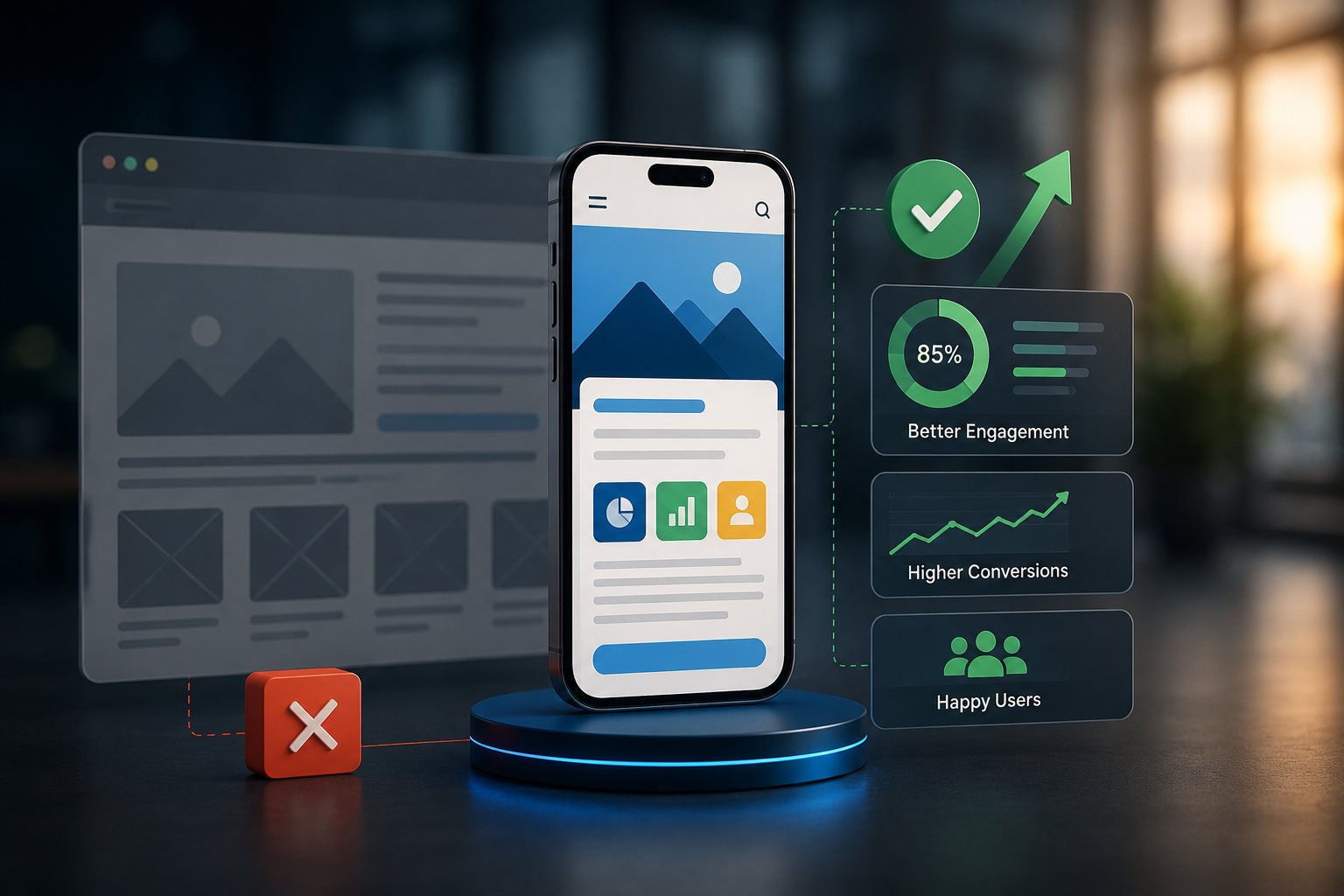
Mobile-First Design: Why Businesses Need to Prioritize Mobile User Experience
Learn why mobile-first design is essential for modern businesses and how UI/UX design improves mobile experiences, customer engagement, and digital growth.

Learn why mobile-first design is essential for modern businesses and how UI/UX design improves mobile experiences, customer engagement, and digital growth.

Discover how UI/UX design improves customer experience, increases conversions, reduces development costs, and drives long-term business growth.

Learn how data visualization helps businesses transform complex data into clear insights, improve decision-making, and unlock the value of analytics solutions.

Learn how business analytics helps companies use data-driven insights to improve decision-making, optimize operations, and achieve better business outcomes.

Discover how predictive analytics helps businesses use AI, data, and machine learning to improve decision-making, forecast trends, and gain a competitive advantage.

Many businesses focus on launching software quickly. To meet deadlines, development teams sometimes choose shortcuts, temporary fixes, or quick solutions that solve immediate problems but create challenges later. This accumulated burden is known as technical debt. While technical debt may help a project move faster initially, ignoring it for too long can significantly increase costs, reduce productivity, and slow business growth.

When businesses think about software development, they often focus on features, functionality, and technology. However, one factor has a direct impact on customer satisfaction, user adoption, and business growth: UI/UX design. Many organizations still view design as a visual enhancement rather than a strategic business investment. In reality, great UI/UX design can significantly influence how users interact with a product and whether they choose to keep using it.

Modern businesses use multiple software tools every day - from CRM platforms and payment gateways to accounting systems and communication tools. While these applications may appear separate, many of them work together seamlessly behind the scenes through API integration.

When launching a new software product, one of the most important decisions businesses face is whether to build a Minimum Viable Product (MVP) or invest in a full-featured solution from the start. While it may be tempting to launch with every feature imaginable, successful companies often take a more strategic approach by starting with an MVP.

As businesses grow, so do their technology demands. What works for a small development team often becomes insufficient as products, customers, and business objectives expand. For today's CTOs and technology leaders, scaling a development team is about more than simply hiring more developers. It requires the right processes, talent strategy, and technology foundation to support sustainable growth.

Artificial Intelligence (AI) is no longer a future technology. It is actively transforming how businesses build, operate, and scale software solutions. From automating repetitive tasks to improving customer experiences and accelerating development cycles, AI is reshaping the custom software development landscape. Businesses that embrace AI-powered solutions are gaining efficiency, reducing costs, and creating smarter digital products.

Businesses often rely on manual processes for years because they seem familiar, affordable, and manageable. Spreadsheets, email chains, paper records, and repetitive administrative tasks may work initially, but as a business grows, these processes can become significant barriers to efficiency and scalability.

Many great software ideas never become successful products - not because the technology fails, but because there was no real market demand. Before investing in custom software development, businesses should validate their idea to ensure they are solving a genuine problem for the right audience.

Spreadsheets are one of the most widely used business tools in the world. They are affordable, flexible, and easy to implement. For startups and small businesses, spreadsheets often work well in the early stages. However, as operations become more complex, relying on spreadsheets can create inefficiencies, errors, and growth limitations.

Building an app can unlock new revenue streams, improve customer experiences, and streamline business operations. However, many businesses rush into development without fully validating their idea, leading to budget overruns, delays, or products that fail to gain traction.

As technology continues to drive business growth, companies face an important decision when expanding their development teams: should they hire in-house developers or use staff augmentation services?

As businesses embrace digital transformation, one question frequently arises: should you buy an existing software solution or invest in custom software development? The answer depends on your business goals, operational requirements, budget, and long-term growth plans. While off-the-shelf software can provide a quick solution, custom software often delivers greater flexibility and competitive advantage.

Many businesses understand the importance of digital transformation, yet they continue to postpone technology investments. The reasons vary - budget concerns, competing priorities, or uncertainty about where to begin. While delaying digital transformation may seem like a way to save money, the reality is often the opposite.

Hiring a software development company is one of the most important decisions a business can make. Whether you're building a mobile app, web platform, or custom business system, the right software development partner can help accelerate growth and improve efficiency.